Academic Projects
Course projects in actuarial modeling, quantitative finance, econometrics, and data analysis.
 Course project
 Bayesian Asian-Option Valuation with MCMC
Bayesian valuation study for Asian options using Metropolis–Hastings inference for geometric-Brownian-motion parameters and posterior simulation to propagate parameter uncertainty into option values.
 Course project
 Systemic Liquidity-Crisis Agent-Based Model
A computational laboratory for systemic liquidity stress. The model connects heterogeneous market participants, stochastic shocks, margin constraints, forced liquidation, stress metrics, and network fragmentation without fixing a public market description that remains under review.
 Course project
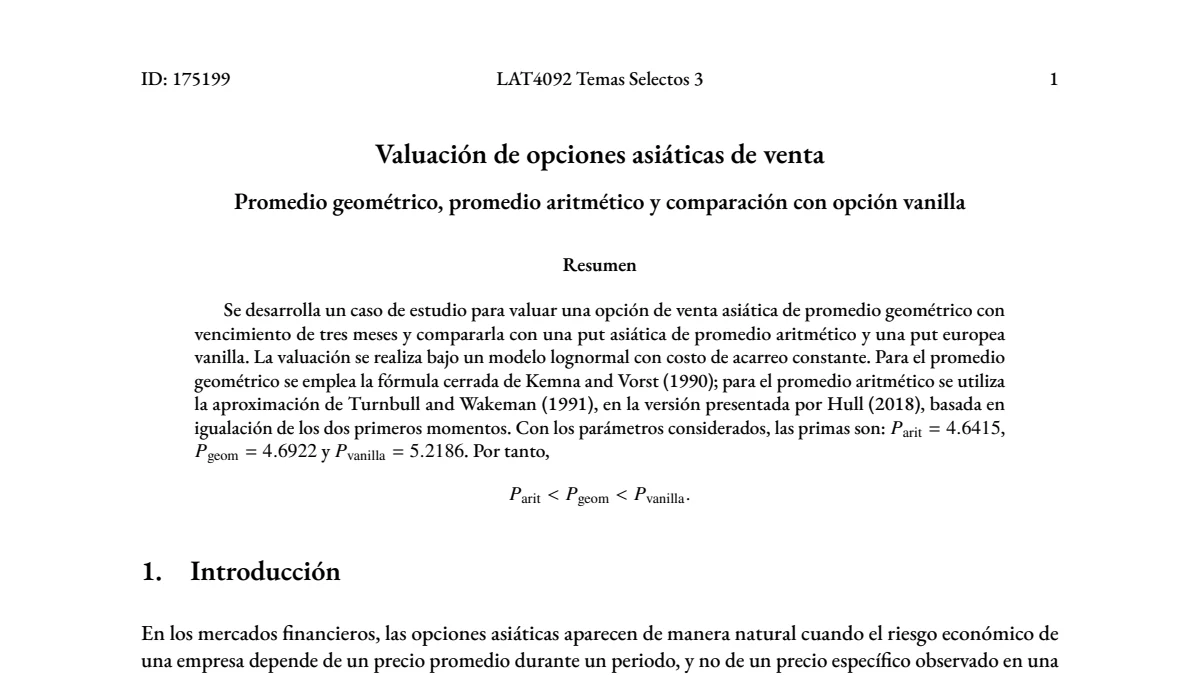
 Asian Put Option Valuation
Case study valuing geometric-average and arithmetic-average Asian put options and comparing both premiums with a European vanilla put under a lognormal model with constant cost of carry.
 Course project
 Cryptocurrency Portfolios
Structural and visual analysis of cryptocurrency portfolios using asset and correlation analysis, efficient-frontier curves, and Monte Carlo simulations with geometric Brownian motion.
 Course project
 Mexico-Linked Futures
Comparative analysis of six futures related to Mexico—corn, WTI crude, silver, MXN/USD, monthly F-TIIE, and the IPC—with pricing, term-structure interpretation, and Mexico-specific implications.
 Course presentation
 Game-Theory Models in Finance
Course presentation on game-theoretic models in asset pricing and corporate finance, motivated by financial phenomena that symmetric-information and perfect-market models do not explain.
 Course project
 Precipitation Time-Series Analysis in Puebla
Time-series study of precipitation in Puebla covering transformations, seasonal differencing, model comparison, model selection, forecasting, and a forecast update.
 Course project
 Credit Scores with Mapper and Homology
Mapped credit-score structure using Mapper and persistent homology for a topological view of credit-score classification.
 Course project
 S&P 500 Supply-Chain Network
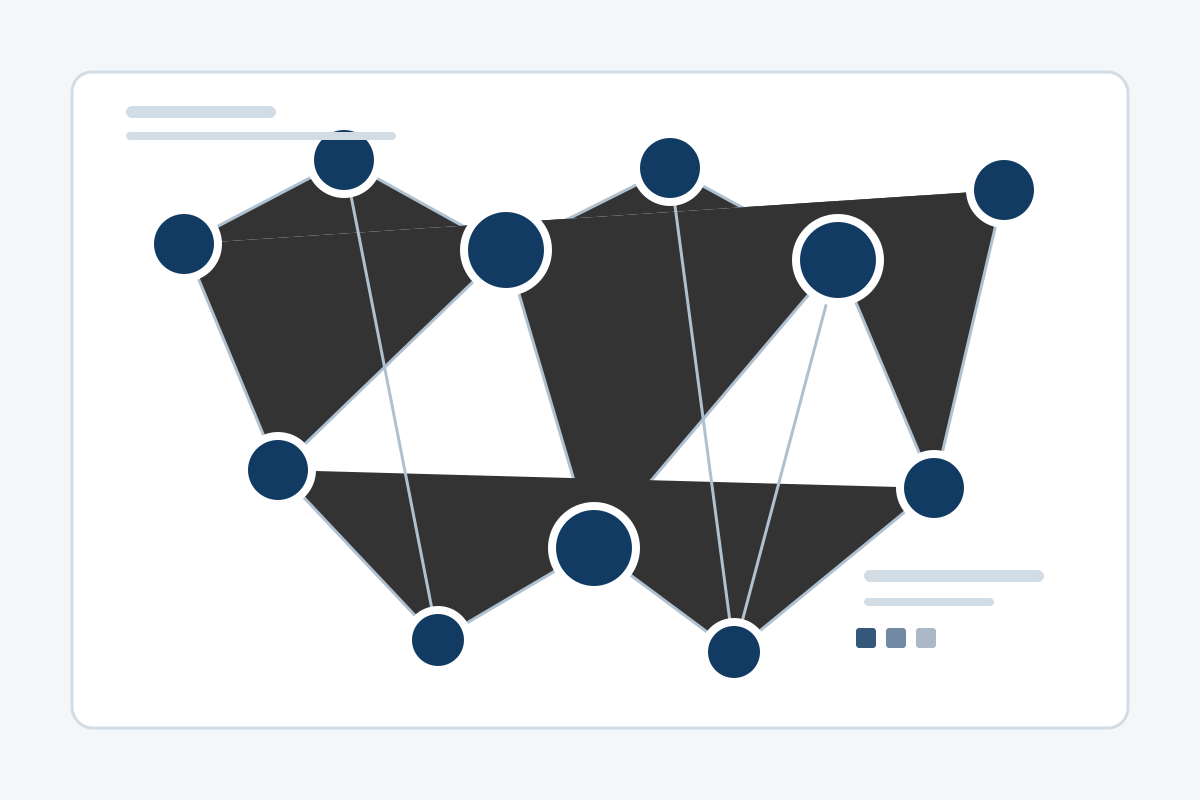
A 30-firm supplier-client network for large S&P 500 companies, represented as a directed graph and analyzed with link-prediction methods after projection to a simple undirected network.
Course project Star Wars Link Prediction
Link prediction on the Star Wars: Episode II character network, where characters are connected when they share scenes and edge weights encode the number of shared scenes.
Course project XGBoost for Credit Approval
A credit-approval classification project using gradient-boosted decision trees, with a reported test accuracy of 87.69%.
Course project Causality Network for Crypto
A cryptocurrency network built from Granger-causality tests and visualized as directed relationships among crypto time series.
Course project Kessler Multiclass Classification
A from-scratch multiclass classifier based on the Kessler construction, reported at 100% accuracy in the course exercise.
 Course project
 Synthetic CDO Tranche Valuation
Valuation of a 12%–22% synthetic CDO tranche using a Gaussian dependence model for portfolio credit losses.
 Course project
 Margrabe Option Derivation
A derivation and application of the Margrabe formula for an option to exchange one risky asset for another.
Course project Multi-Leg Derivative Strategies
Pricing and payoff analysis for exotic options and multi-leg derivative strategies in the Exotic Derivatives course.
Course portfolio Actuarial Risk Analysis Portfolio
A course portfolio covering practical analysis of market, credit, operational, and liquidity risk.
 Course project
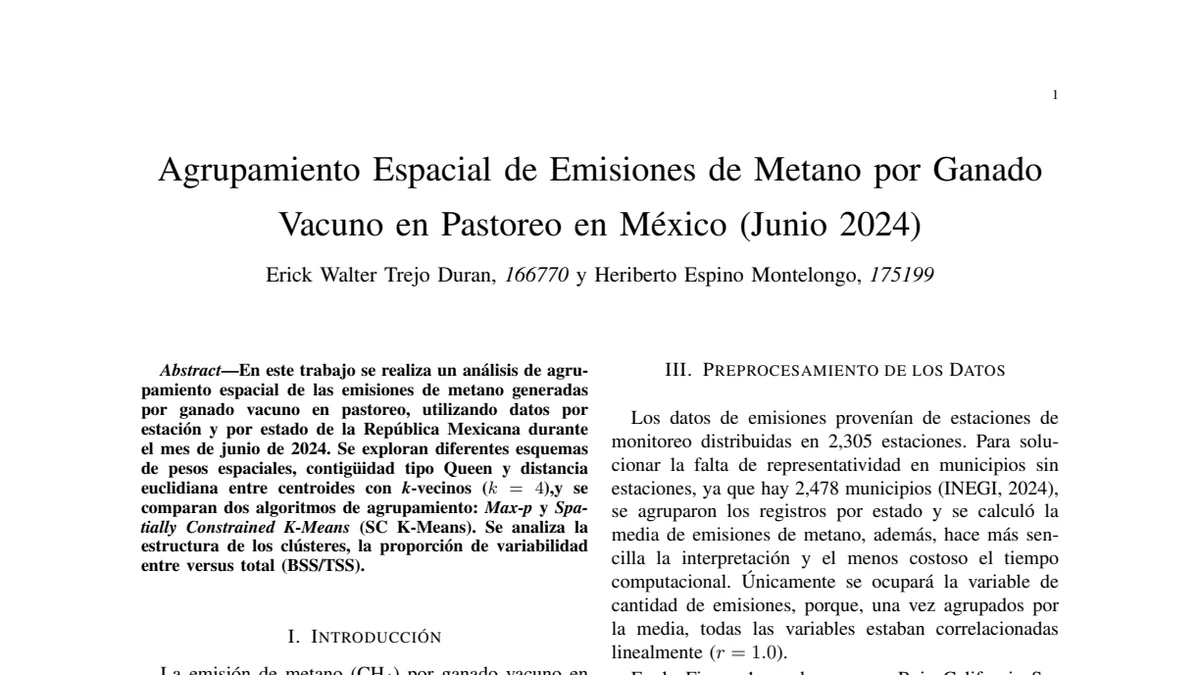
 Agrupamiento Espacial de Emisiones de Metano por Ganado Vacuno en Pastoreo en México
A spatial-clustering analysis of methane emissions from grazing cattle in Mexico using station and state data for June 2024. It compares Queen contiguity and centroid-distance \(k=4\) weights with Max-p and Spatially Constrained K-Means, evaluating cluster quality through the between-to-total variability ratio \(BSS/TSS\).
 Course project
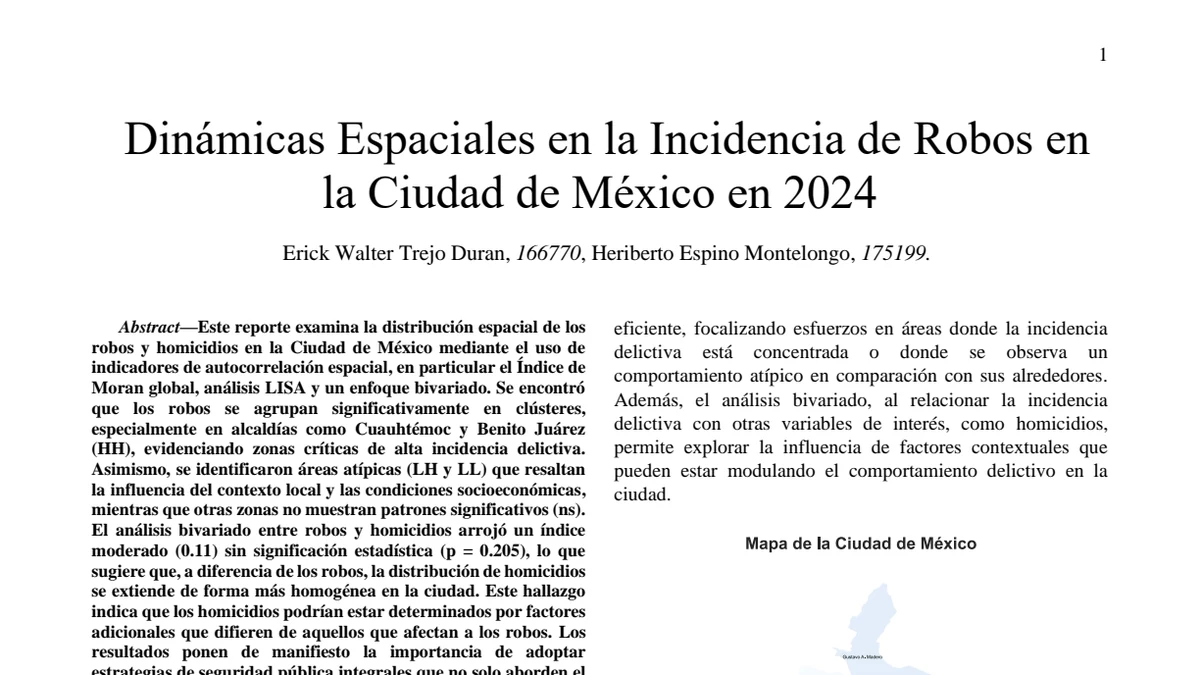
 Dinámicas Espaciales en la Incidencia de Robos en la Ciudad de México en 2024
A spatial analysis of theft and homicide incidence in Mexico City during 2024 using global Moran’s \(I\), LISA, and a bivariate approach. The bivariate theft–homicide association is reported as \(I=0.11\) with \(p=0.205\), while local results distinguish HH, LH, LL, and non-significant areas.
 Course project
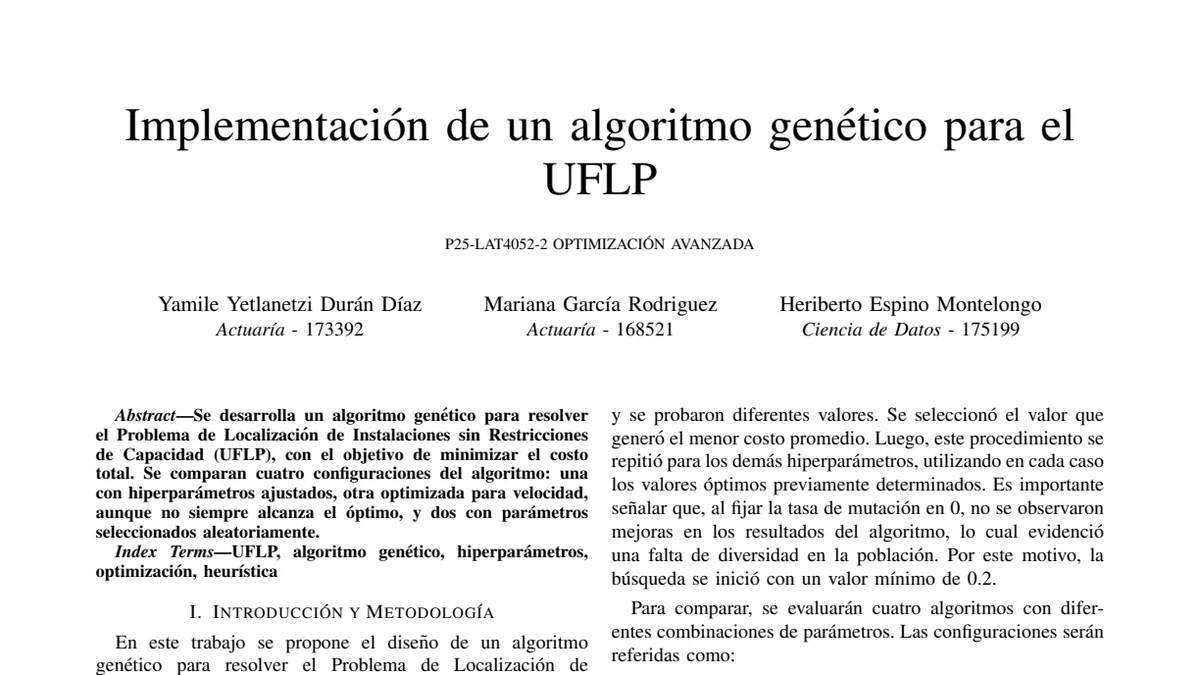
 Implementación de un Algoritmo Genético para el UFLP
A genetic-algorithm implementation for the uncapacitated facility location problem (UFLP), with the objective of minimizing total operating and assignment cost. It compares four configurations while fixing population size \(N=100\) and maximum generations \(G=30\) during hyperparameter tuning.
 Course project
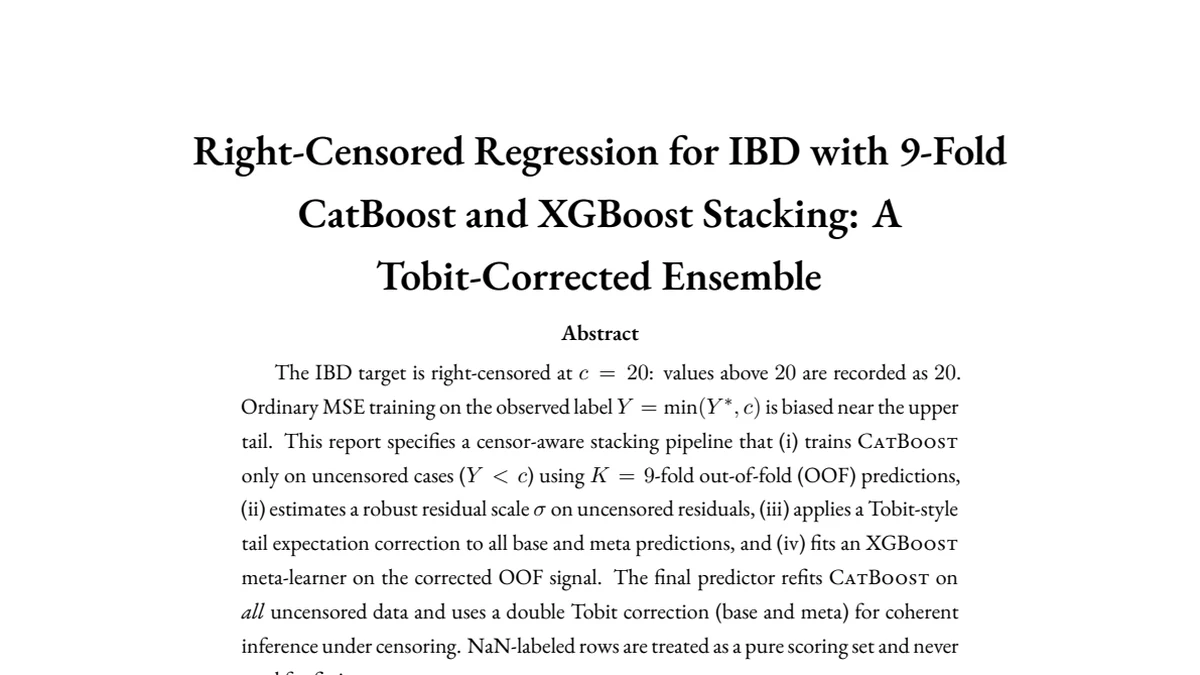
 Right-Censored Regression for IBD with CatBoost and XGBoost Stacking
A censor-aware stacking pipeline for an IBD target right-censored at \(c=20\). CatBoost is trained on uncensored cases using \(K=9\)-fold out-of-fold predictions, a robust residual scale is estimated, and Tobit-style tail corrections are applied before XGBoost meta-learning.