Papers
Manuscripts under review and research projects in stochastic and computational geometry.
 Manuscript
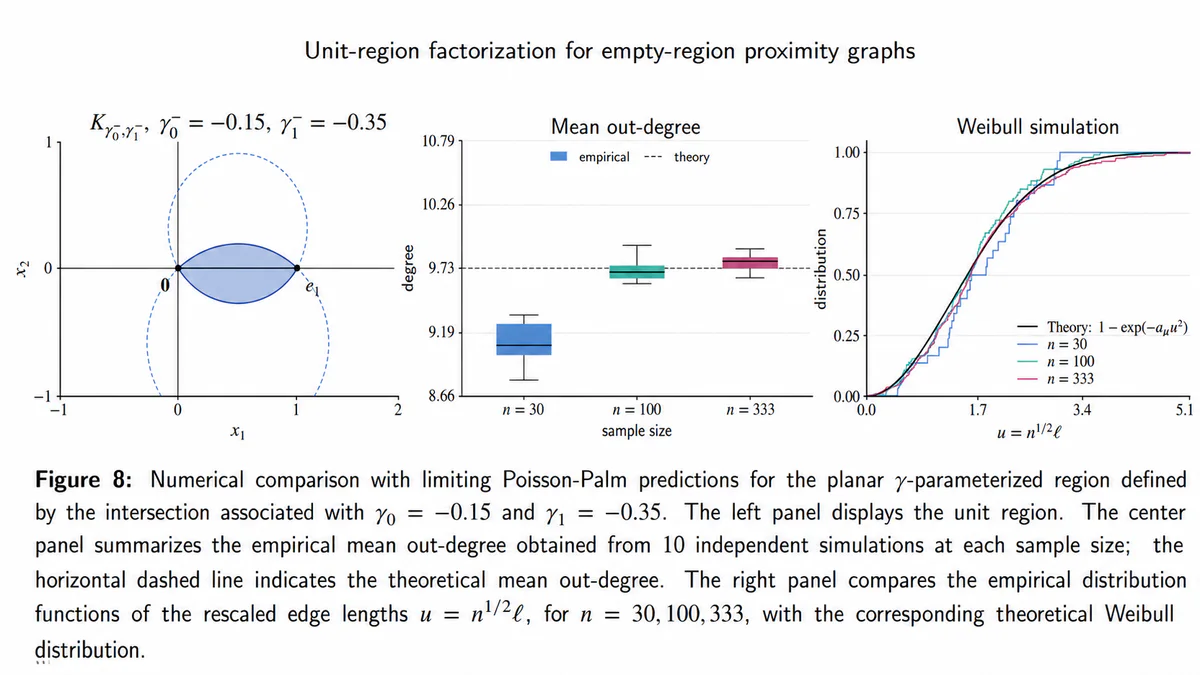
 Unit-Region Factorization for Empty-Region Proximity Graphs
A fixed-template empty-region rule assigns a Borel region \(S(p,q)\) to a candidate pair and retains the edge when that region contains no other site. The manuscript isolates the unit-volume constant \(a_K\) for similarity-copy regions and shows how the same scalar controls exact Poisson void probabilities, incident-edge length intensities, mean out-degree, and normalized incident-edge length laws.
 Manuscript
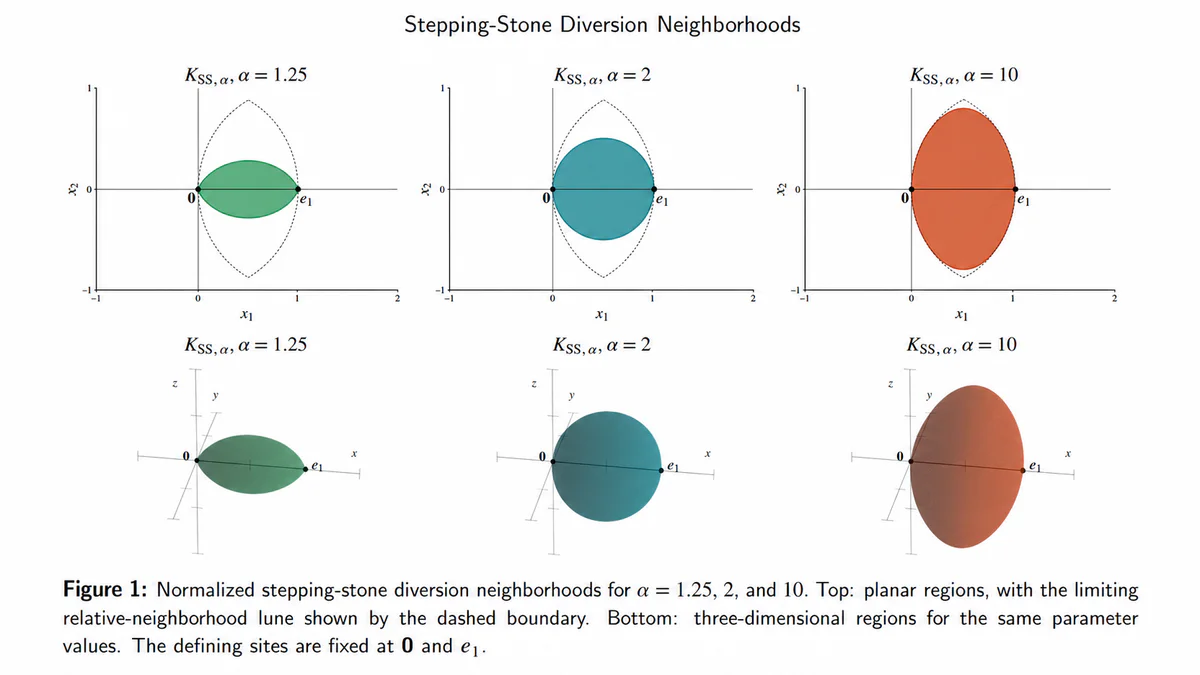
 Geometry and Volume of Stepping-Stone Diversion Neighborhoods in Euclidean Spaces of Arbitrary Dimension
This manuscript develops a geometric, graph-theoretic, and probabilistic analysis of the stepping-stone graph in \(\mathbb{R}^d\) for every \(d\geq 2\). It derives a normalized one-dimensional volume integral, recovers the degenerate and Gabriel cases and the relative-neighborhood limit, proves strict region and volume monotonicity, establishes graph inclusions and connectivity, and validates a stable quadrature formula by rejection sampling.
 Working paper
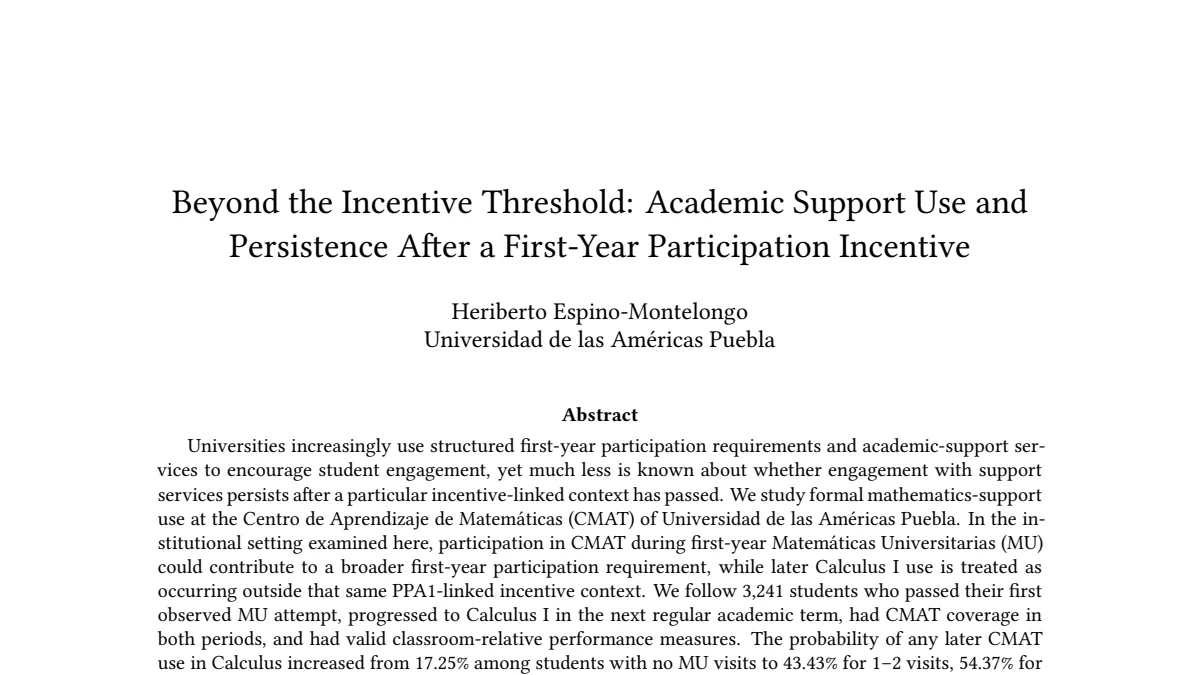
 Beyond the Incentive Threshold: Academic Support Use and Persistence After a First-Year Participation Incentive
A longitudinal study of \(n=3{,}241\) students examining whether formal mathematics-support use persists from an incentive-linked first-year context into later Calculus I use after that same incentive context is no longer assumed to apply.
 Research draft
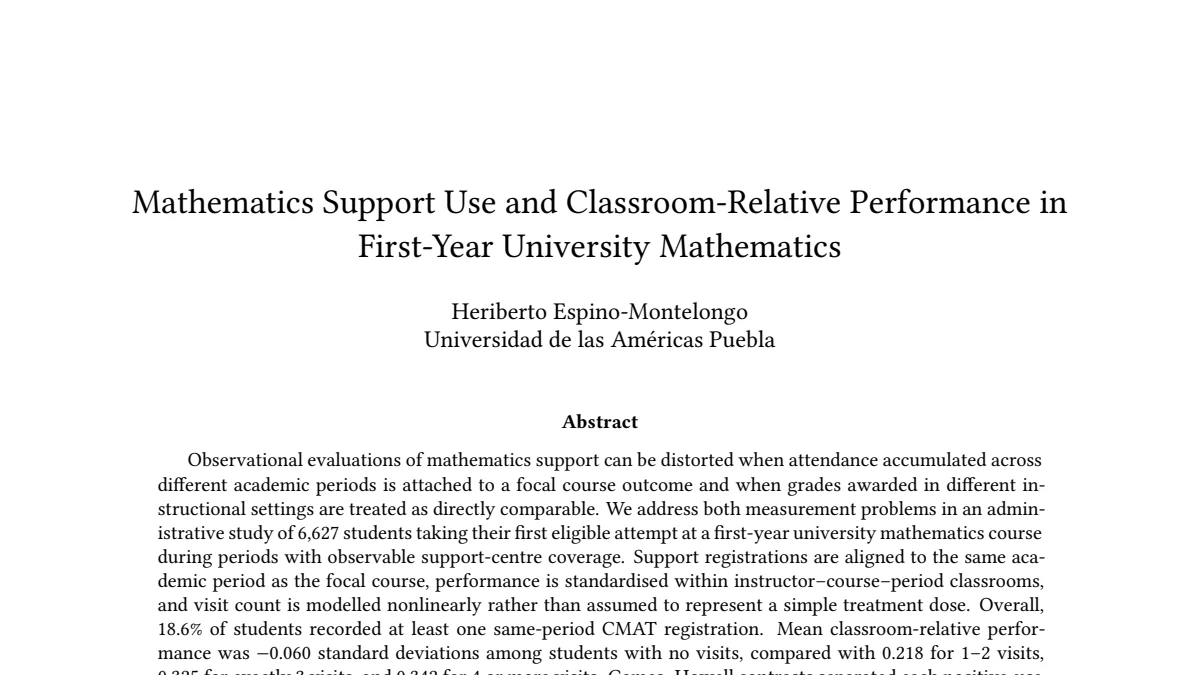
 Mathematics Support Use and Classroom-Relative Performance in First-Year University Mathematics
An observational study of \(n=6{,}627\) first-year mathematics students linking same-period mathematics-support use to classroom-relative academic performance while keeping self-selection and non-causal interpretation explicit.
 Research draft
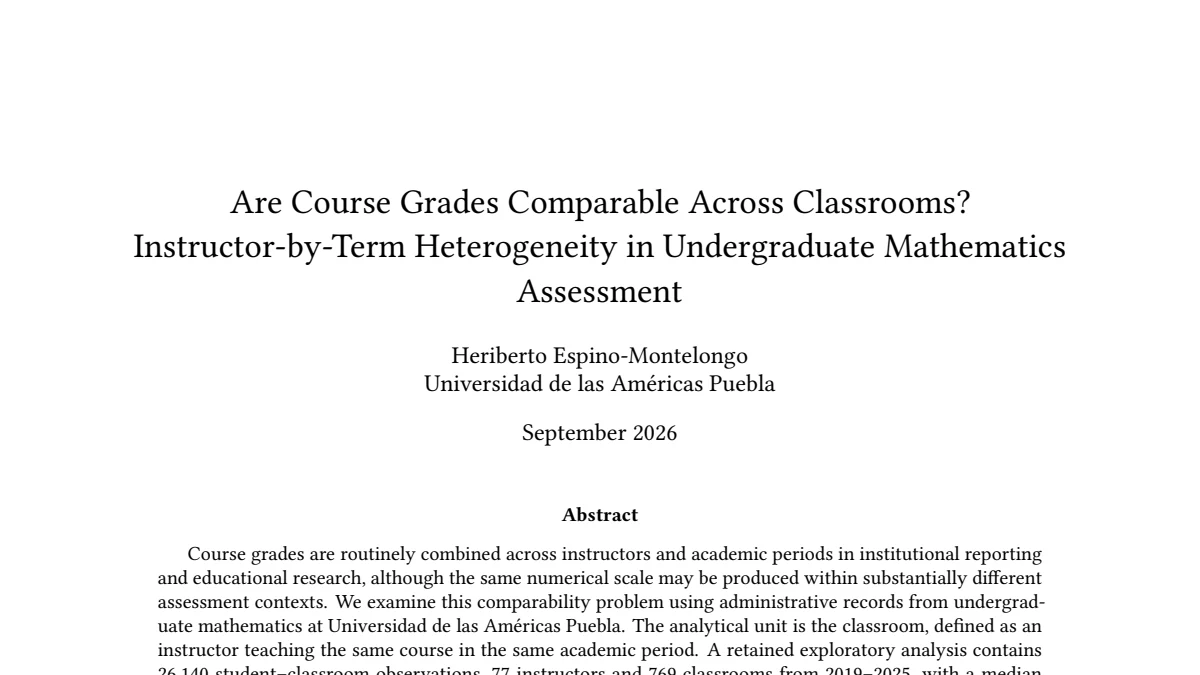
 Are Course Grades Comparable Across Classrooms? Instructor-by-Term Heterogeneity in Undergraduate Mathematics Assessment
A measurement study of classroom-level grade heterogeneity in undergraduate mathematics, asking whether a common numerical grade \(g\) can be treated as empirically exchangeable across instructor-by-term contexts.
 Research draft
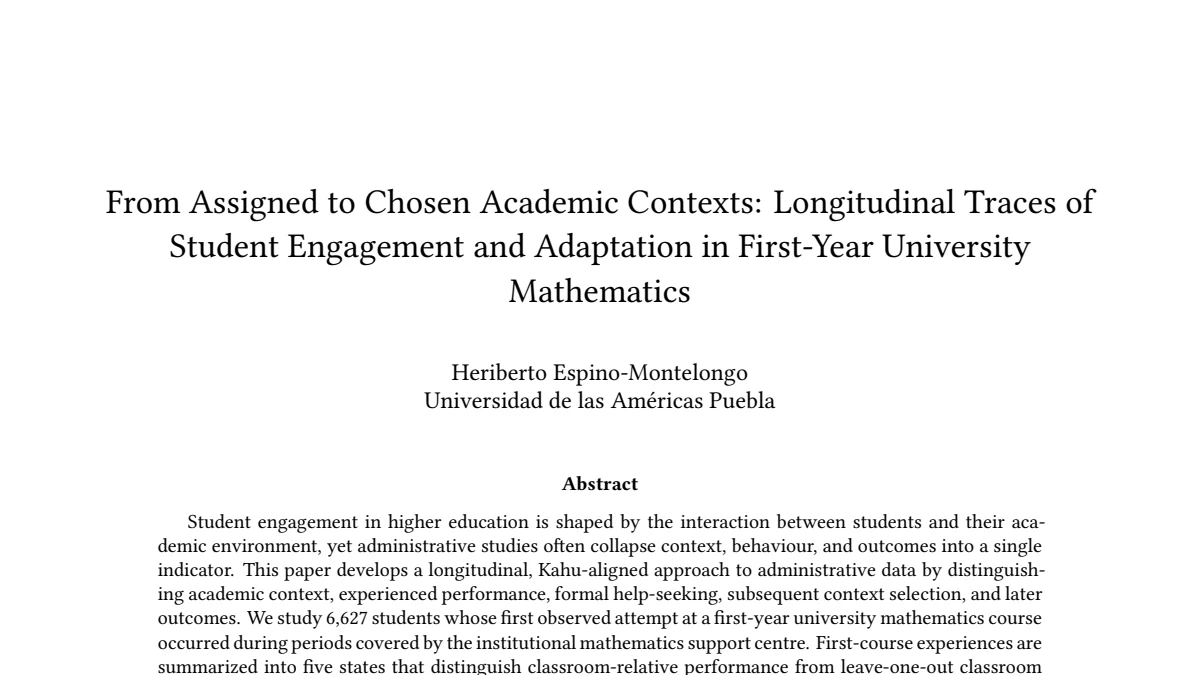
 From Assigned to Chosen Academic Contexts: Longitudinal Traces of Student Engagement and Adaptation in First-Year University Mathematics
An administrative-data study of \(n=6{,}627\) students that distinguishes academic context, experienced performance, formal help-seeking, later context selection, and subsequent outcomes. The analysis identifies five first-course states, examines later Calculus enrolment, and follows adaptation after failed first-course attempts while keeping the findings descriptive rather than causal.
 Research paper
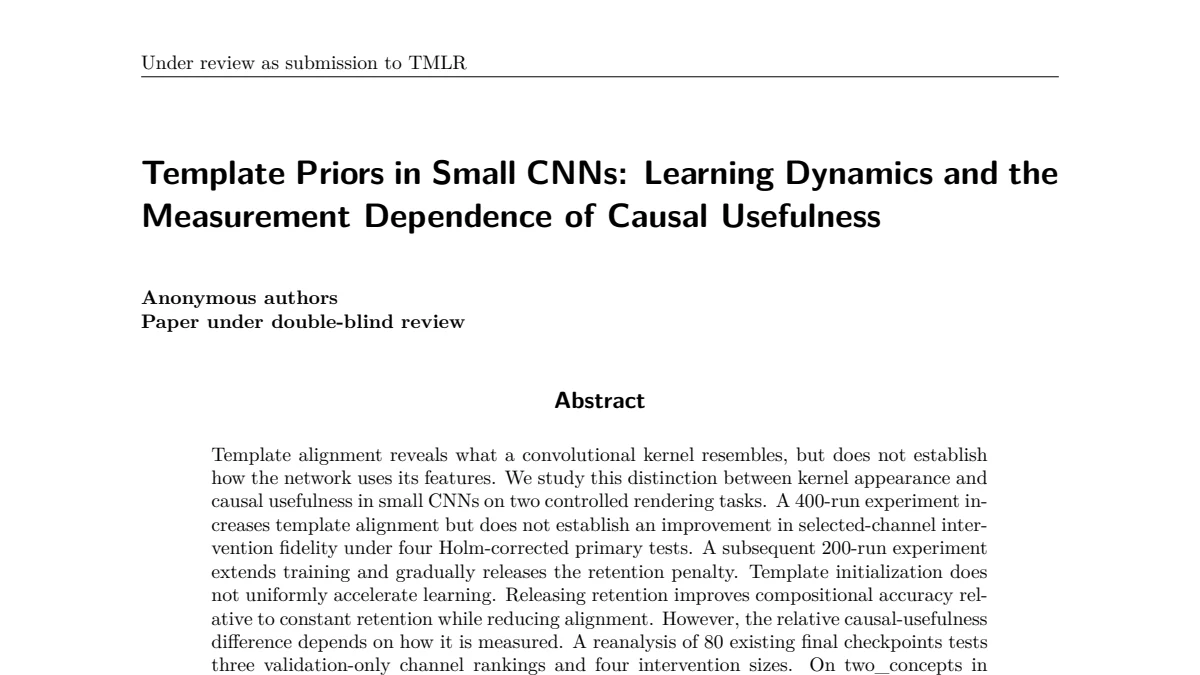
 Template Priors in Small CNNs: Learning Dynamics and the Measurement Dependence of Causal Usefulness
A controlled study of template initialization, retention, and release in small CNNs on two rendering tasks. Across staged experiments with \(n=400\) primary runs, \(n=200\) gradual-release runs, \(80\) final checkpoints, and \(2{,}000\) saved states, template initialization does not uniformly accelerate learning; releasing retention improves compositional accuracy relative to constant retention while reducing alignment; and the relative causal-usefulness difference changes with channel ranking and intervention size.
 Working paper
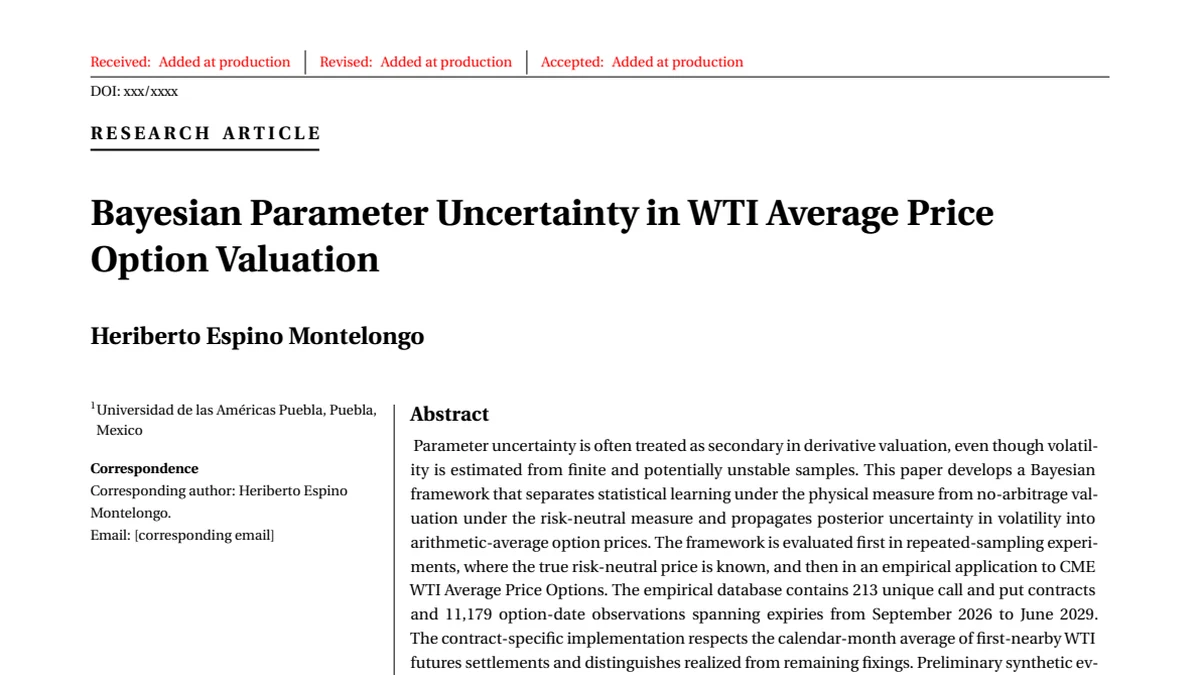
 Bayesian Parameter Uncertainty in WTI Average Price Option Valuation
A working study of Bayesian parameter uncertainty in WTI average-price option valuation. It separates statistical learning under the physical measure from no-arbitrage valuation under the risk-neutral measure and propagates posterior uncertainty in volatility into arithmetic-average option prices. The empirical design combines \(213\) unique call and put contracts with \(11{,}179\) option-date observations spanning September 2026 to June 2029.
 Software project
 Guerrero Penalized Trend Estimation
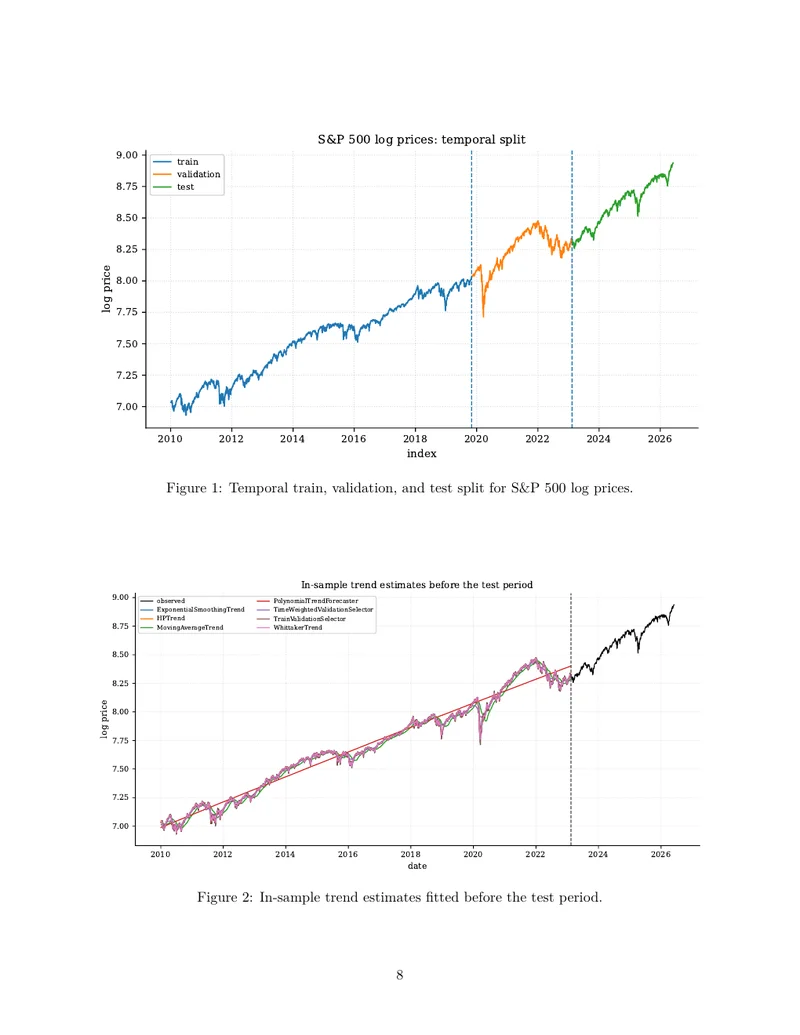
Empirical comparison of train-validation smoothness selection for penalized trends (\widehat{t}(\lambda)) against time-weighted validation and benchmark methods on S&P 500 log prices. The design uses a strict temporal train/validation/test protocol and separates Guerrero smoothness from realized roughness diagnostics.